

Coffee's Secret Weapon
The Bacteria You Never Knew You Needed (And the Chemistry You Definitely Need to Understand)

Why your morning brew is more than a caffeine fix—it’s a gut renovation project.

Let me start with a confession: I used to love coffee. Not in that “I can’t function without it” sort of way (okay, maybe a little), but in that “there’s something profoundly satisfying about a well-brewed cup” kind of way. And if you’re reading this while sipping your third cup of the day, you’re in good company—and apparently, you’re hosting a very special guest in your gut that non-coffee drinkers don’t have.
But before we get to that bacterial VIP, we need to talk chemistry. Because here’s the thing: coffee doesn’t contain polyphenols. And if you’ve been parroting that phrase at dinner parties, it’s time to upgrade your vocabulary.
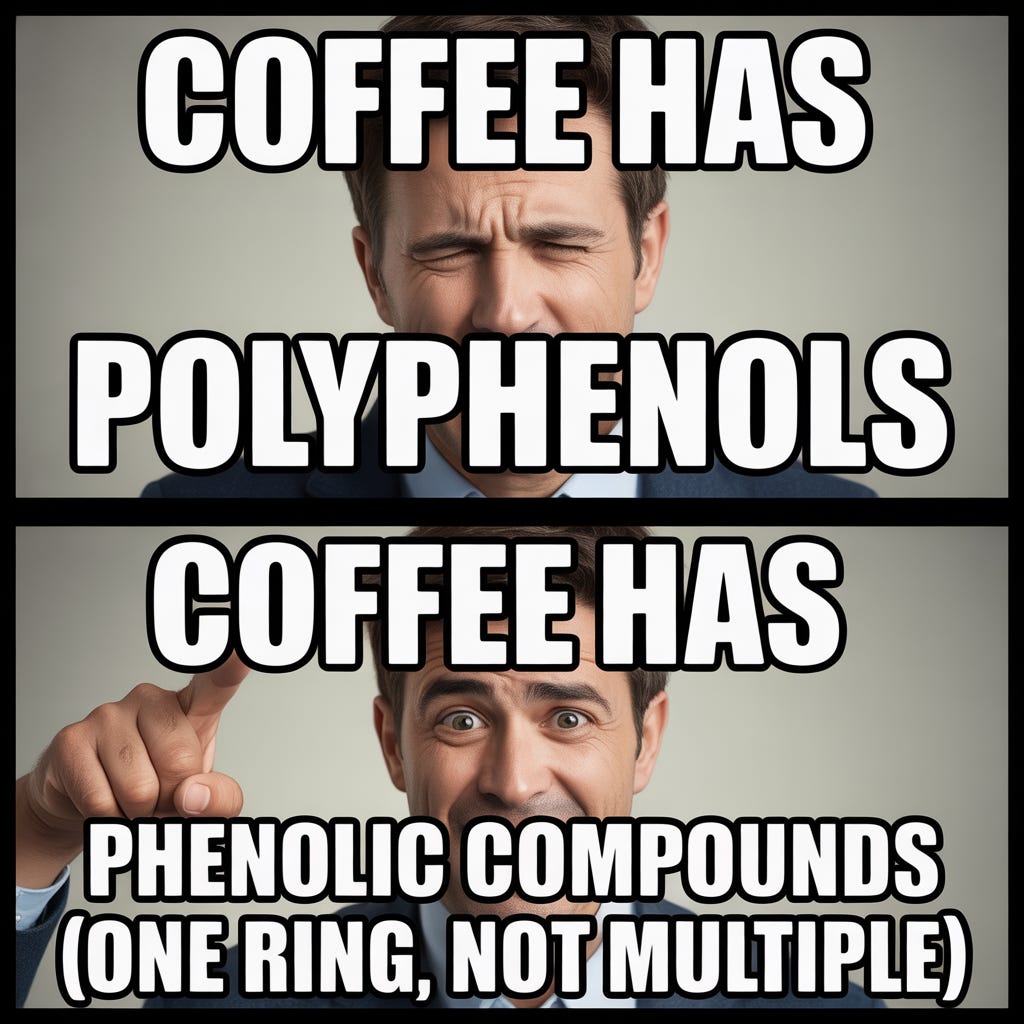
Phenolic Compounds vs. Polyphenols: It’s All About the Rings, Baby
Let’s clear this up once and for all. When people say coffee is rich in “polyphenols,” they’re technically wrong—and in science, “technically wrong” is just... wrong.
Here’s the deal: Phenolic compounds have ONE aromatic ring. Polyphenols have MULTIPLE aromatic rings. It’s literally in the name: poly = many, phenol = aromatic ring with a hydroxyl group (-OH) attached.
Think of it like this: If phenolic compounds are a single-story house, polyphenols are a multi-story apartment building. Both have the same basic structure (they’re both buildings), but one is distinctly more complex than the other.
Coffee is loaded with chlorogenic acids—a significant class of phenolic compounds. These are simple, single-ring structures that pack a powerful punch. When you see “flavonols” mentioned in relation to coffee, run the other direction—flavonols require multiple rings, and coffee doesn’t have them. The primary phenolic players in coffee are chlorogenic acid, caffeic acid, and quinic acid—all single-ring phenolic compounds.
Why does this matter? Understanding the actual chemistry helps us know how coffee works in your body. These simpler phenolic compounds are metabolised differently than complex polyphenols, and that metabolic pathway is precisely what makes coffee so unique in its effects on your gut.
The Poop Button: Coffee’s Not-So-Secret Superpower
Alright, let’s address the elephant in the room—or rather, the urgency in the bathroom. Coffee makes you poop. We all know it. But here’s the kicker: it’s not the caffeine.
Studies using decaffeinated coffee show the same gastrointestinal effects, which means something else is pulling the strings. When coffee hits your stomach, particularly after a meal, it stimulates gastric acid secretion—your stomach literally starts working overtime. But the real magic happens further down the line, in your enteric nervous system.
Coffee directly affects the muscarinic receptors in your gut’s enteric nervous system—the same receptors that atropine (a pharmaceutical anticholinergic) blocks. These muscarinic receptors, when stimulated, cause smooth muscle contractions in your intestinal wall, triggering peristalsis and giving you that unmistakable “I need to find a restroom NOW” sensation.
Interestingly, nicotine works through a similar mechanism, stimulating the enteric nervous system and promoting gut motility. So if you’re someone who drinks coffee AND smokes (though I’m not recommending this combo, obviously), you’re essentially hitting the accelerator twice on your gut’s motor function. The synergistic effect can be... dramatic.
The precise compound in coffee responsible for this muscarinic receptor activation remains a mystery—but research is ongoing, and I’m hopeful we’ll have answers in the near future.

Meet Your New Gut Resident: Lawsonibacter asaccharolyticus
Now here’s where it gets truly fascinating. In 2024, a groundbreaking study published in Nature Microbiology analyzed the gut microbiomes of over 23,000 people across the US and UK, and they found something remarkable: coffee consumption is associated with a specific bacterium called Lawsonibacter asaccharolyticus—and this bacterium is virtually absent in non-coffee drinkers.
Let me repeat that: This is the first time researchers have identified a definitive microbiome difference linked to a single food or beverage. Coffee drinkers harbor this unique bacterial species; non-coffee drinkers don’t.
L. asaccharolyticus was only discovered in 2018, so we’re still learning about it, but here’s what we know: it produces butyrate. And if you know anything about gut health, you know butyrate is gold.
Butyrate is a short-chain fatty acid that serves as the primary energy source for your colonocytes (the cells lining your colon). It enhances intestinal barrier function, exhibits anti-inflammatory properties, and is associated with better metabolic health. In other words, this little bacterium might be one of the reasons coffee consumption is consistently linked to reduced risks of heart disease, type 2 diabetes, and colon cancer.
The study found that regular coffee drinkers had 4.5 to 8 times higher levels of L. asaccharolyticus compared to those who never drank coffee. The effect was dose-dependent (more coffee = more bacteria) and consistent across both caffeinated and decaffeinated varieties, confirming that caffeine isn’t the key player here.
When researchers cultured L. asaccharolyticus in the lab and added coffee to the growth medium, the bacteria grew faster—direct evidence that something in coffee specifically feeds this microbe.
The Metabolic Pathway: From Coffee to Butyrate
So what’s the mechanism? How does coffee specifically promote L. asaccharolyticus growth?
The leading hypothesis centers on chlorogenic acid—one of those phenolic compounds we talked about earlier. When chlorogenic acid is metabolized in your gut, it breaks down into smaller metabolites, including quinic acid and caffeic acid.
The 2024 study found elevated levels of quinic acid in the blood of coffee drinkers who also had higher levels of L. asaccharolyticus. This suggests that L. asaccharolyticus may be metabolizing these phenolic breakdown products, using them as fuel, and in the process, producing butyrate.
It’s a beautiful metabolic dance: Coffee’s phenolic compounds → gut metabolism → quinic acid → L. asaccharolyticus growth → butyrate production → improved gut health.
Why This Matters (Especially for Keto and Carnivore Folks)
If you’re following a ketogenic or carnivore way of eating, you’re probably already familiar with the importance of gut health despite lower fiber intake. Coffee might be one of your secret weapons.
While plant-based fiber is traditionally seen as the primary fuel for beneficial gut bacteria, coffee appears to operate through a different pathway entirely—one that’s independent of fiber and carbohydrate content. This means even on a very low-carb or zero-carb diet, coffee can still support a healthy gut microbiome by promoting L. asaccharolyticus and butyrate production.
This aligns with what I’ve observed in my clinical practice: many successful keto and carnivore adherents are avid coffee drinkers, and they maintain excellent gut health markers despite minimal plant food intake.
The Bottom Line (No Pun Intended)
Coffee is far more complex than we ever imagined. It’s not just a caffeine delivery system or a pleasant morning ritual—it’s a biochemical intervention that:
Contains phenolic compounds (NOT polyphenols)—simple, single-ring molecules that are metabolized into active compounds like quinic acid
Stimulates your enteric nervous system via muscarinic receptors, triggering gut motility (the exact compound responsible is still under investigation)
Promotes the growth of Lawsonibacter asaccharolyticus, a unique butyrate-producing bacterium found almost exclusively in coffee drinkers
Works independently of caffeine—decaf shows the same effects
May contribute to coffee’s protective effects against chronic diseases through gut microbiome modulation
So the next time someone tells you coffee is “bad for your gut,” you can politely correct them—with science.
Closing Thoughts: Brew On, My Friends
I started this article with a confession of my love for coffee, and I’ll end with another: I’m endlessly fascinated by how something as simple as a roasted bean and hot water can orchestrate such complex biological effects. From stimulating muscarinic receptors we’re still studying to feeding bacteria we only discovered six years ago, coffee remains one of the most intriguing beverages in nutritional science.
So go ahead—pour yourself another cup. Your gut (and your resident Lawsonibacter colony) will thank you.
And if anyone asks why you’re on your third bathroom trip of the morning, just smile knowingly and say, “It’s the muscarinic receptors, darling.”
Until next time, keep questioning the conventional wisdom and following the science.
— Stephen
PS.
Now, before you assume I’m about to set up a loyalty card at my local roaster again, let me take a coffee break (pun intended) for some personal context. For years, I tried every possible way to make coffee as clean as nature allows—freshly roasted beans, Swiss water process decaf, you name it. Despite these efforts, I noticed something undeniable: when I removed coffee from my routine, my joint pain and inflammation markedly improved. It was a night-and-day difference, and for me, it’s enough to keep my intake very limited, no matter how alluring the emerging science about coffee’s benefits is.
One likely culprit? Acrylamide. This chemical forms naturally during high-temperature roasting, not just in coffee, but also in foods like toast, fries, and cereals. (a) (b) (c)
Acrylamide is a byproduct of the Maillard reaction—the same chemical process that gives coffee its characteristic browned flavor and aroma. While research is ongoing, studies suggest that acrylamide can trigger inflammatory responses in the body, increase oxidative stress, and may contribute to various health risks, including joint pain and inflammation in susceptible individuals. (d)
Even using the cleanest Swiss water decaf and obsessively sourcing beans couldn’t completely eliminate acrylamide in my cup. While it’s tempting to dive back in and use the latest data on butyrate, the microbiome, and all those lovely phenolic compounds to justify “just one more cup,” facts are facts. Acrylamide is present, and its effects—at least for me—are unmistakable.
That’s why my aim in sharing this article is never to prescribe, but to present evolving knowledge as objectively and honestly as possible. Your experience may be totally different, and you may thrive with coffee as part of your daily routine—these new discoveries might help explain why. I simply lay out the facts so you can make informed decisions for yourself. Coffee isn’t technically “carnivore,” but if you’re one of the many people sipping it and thriving, that’s a data point worth celebrating.
References For The Main Article
Gallego-Barceló, P., Benítez-Álvarez, D., Bagües, A., Silván-Ros, B., Montalbán-Rodríguez, A., López-Gómez, L., Vera, G., del Castillo, M. D., Uranga, J. A., & Abalo, R. (2024). Ex vivo study of colon health, contractility and innervation in male and female rats after regular exposure to instant cascara beverage. Foods, 13(16), 2474. https://doi.org/10.3390/foods13162474
Hegde, S., Shi, D. W., Johnson, J. C., Geesala, R., Zhang, K., Lin, Y.-M., & Shi, X.-Z. (2022). Mechanistic study of coffee effects on gut microbiota and motility in rats. Nutrients, 14(22), 4877. https://doi.org/10.3390/nu14224877
Iriondo-DeHond, A., Uranga, J. A., del Castillo, M. D., & Abalo, R. (2021). Effects of coffee and its components on the gastrointestinal tract and the brain-gut axis. Nutrients, 13(1), 88. https://doi.org/10.3390/nu13010088
Manghi, P., Bhosle, A., Wang, K., Marconi, R., Selma-Royo, M., Ricci, L., Asnicar, F., Golzato, D., Ma, W., Hang, D., Thompson, K. N., ... Segata, N. (2024). Coffee consumption is associated with intestinal Lawsonibacter asaccharolyticus abundance and prevalence across multiple cohorts. Nature Microbiology, 9(12), 3120–3134. https://doi.org/10.1038/s41564-024-01858-9
Nehlig, A. (2022). Effects of coffee on the gastrointestinal tract: A narrative review and literature update. Nutrients, 14(2), 399. https://doi.org/10.3390/nu14020399
Sakamoto, M., Iino, T., Yuki, M., & Ohkuma, M. (2018). Lawsonibacter asaccharolyticus gen. nov., sp. nov., a butyrate-producing bacterium isolated from human faeces. International Journal of Systematic and Evolutionary Microbiology, 68(6), 2074-2081. https://doi.org/10.1099/ijsem.0.002800
Tajik, N., Tajik, M., Mack, I., & Enck, P. (2017). The potential effects of chlorogenic acid, the main phenolic components in coffee, on health: A comprehensive review of the literature. European Journal of Nutrition, 56(7), 2215-2244. https://doi.org/10.1007/s00394-017-1379-1
Song, M., & Segata, N. (2025). Coffee consumption and gut microbiome interactions: Latest findings from the ZOE PREDICT study. Nature Microbiology.
UCLA Health. (2025, February 10). Study suggests coffee is good for gut microbiome. https://www.uclahealth.org/news/article/study-suggests-coffee-good-gut-microbiome
Manian, C. (2024, December 10). How coffee might change your gut, according to new research. Health. https://www.health.com/coffee-change-gut-microbiome-health-8756603
References for my experience with joint pain and coffee
A. https://www.fda.gov/food/process-contaminants-food/acrylamide-and-diet-food-storage-and-food-preparation
B. https://www.mdpi.com/2304-8158/13/4/556
C. https://pubs.acs.org/doi/10.1021/acsfoodscitech.4c00801
D. https://pmc.ncbi.nlm.nih.gov/articles/PMC11699442/
Want to dive deeper into the science of metabolic health? Visit www.theukcarnivore.com or join our community at https://www.skool.com/low-carb/about
It’s amazing how much smarter I am because of you, Stephen. If I had a nickel for every time a health professional said coffee contained polyphenols, I would have enough money to pay for your subscription. I may anyway , but I’m now wary because of what Substack is doing in Australia.
Back to the subject at hand, I think I mentioned in a comment to a previous post that I have been drinking coffees for 70 years, having gone through the “it’s good/it’s bad” cycle countless times. I’ve tried to quit and now reduced my intake to 8oz/day. I don’t know how much acrylamide is in that cup, but I suspect it’s far less than what I get from bacon, steak or other grilled meat that I consume and certainly far less that what I have consumed over a lifetime experience with Maillard reactions. So, I’m not concerned with the carcinogenic aspect, but I don’t know if after removing virtually everything else in my diet that is inflammatory, is coffee problematic?
Purity coffee claims to have reduced acrylamide content in their coffee to almost zero, through their roasting process. I may give it a try.
Anyway, I do appreciate this post. You’re about the only person I’ve come across who doesn’t cite surveys, studies, meta-analyses for justification for this or that, but use real science.
Thanks again.
Coffee contains kahweol and cafestol, diterpenes that can raise cholesterol by inhibiting bile acid synthesis. Using paper filters removes these, unlike French presses. My view: coffee is a complex chemical cocktail; while it feeds beneficial bacteria, its metabolic trade-offs depend entirely on your brewing method.