

Heart Rate Variability (Re-Posted)
The “Hipster Avocado Toast” of Biometrics, or Actually Useful? (And should you really trust your Fitbit more than your feelings?)

There was a time when saying “I tracked my heart rate variability (HRV) this morning!” would get you the same look as announcing you monitor the viscosity of your nasal mucus. Today, between wearables, sleep apps, and breathwork influencers, HRV is so hot right now it’s practically got its own reality show. But what is HRV, why is everyone obsessed, where did it come from, and is it REALLY telling us anything meaningful about our health — or is it just another biohacker badge, beloved most by those already annoyingly healthy? Let’s demystify HRV — and see if healthy user bias is driving the hype, or if the science really delivers.
Heart Rate Variability, Explained (in Human-Speak)
Heart Rate Variability is the variation in the time intervals between consecutive heartbeats. It’s not about your actual heart rate (like “83 beats per minute”), but rather how much the spacing between those beats wiggles around. The more variable (within the normal range), the better — at least, in most contexts. High HRV is associated with a robust, adaptable autonomic nervous system. At the same time, low HRV is often linked to stress, fatigue, disease risk, and generally having “a nervous system running on dial-up.”
Where’d HRV Come From, and Why Are We Talking About It Now?
HRV measurement has its roots in clinical cardiac research of the mid-20th century, with early studies linking low HRV to poor outcomes after heart attacks. In the last decade, though, two things happened:
Technology got cheap and non-invasive (photoplethysmography, PPG, and later, wrist-worn and wearable devices), making real-time HRV accessible to the masses.
The wellness/quantified self movement exploded, and folks started using HRV as a “window into stress, recovery, and even mental health,” especially among athletes, meditators, and anyone wanting to ‘optimise.’
Is HRV Actually Useful? What Do the Studies Say?
HRV is viewed as a robust physiological biomarker in research. It’s not just about fitness: it reflects the intricate interplay between the sympathetic (“fight-or-flight”) and parasympathetic (“rest-digest”) nervous systems. High HRV generally indicates good adaptability and resilience, while persistently low HRV is associated with cardiovascular risk, cognitive decline, and chronic stress.
But here’s the reality check:
While population and cohort studies consistently show associations between HRV and health outcomes, the “causal” relationship is both complex and still under debate. Most studies are cross-sectional, not longitudinal; only some demonstrate that interventions designed to boost HRV (such as meditation) also improve health outcomes over the long run.
The accuracy of consumer wearables, especially during movement or sleep, is variable at best, and new guidelines are only now standardising research best practices.
HRV’s ability to predict acute health events (e.g., heart attacks) or mental state, while promising, is not universally reliable outside controlled settings.
Is “Healthy User Bias” a Problem in HRV Hype?
Absolutely. Much like kale smoothies and boutique gyms, HRV is most religiously tracked by health-conscious folks who already do all the “good things” — exercise, sleep, meditate, eat clean. Studies on wearables and wellness tracking consistently show adoption skews towards young, tech-savvy, already-healthy populations. Outcomes may be distorted because the people who regularly use and act on HRV feedback are the least likely to get sick anyway. In short, is HRV a sign of your health, or just your health-consciousness?
Conclusion (Plus My Unsolicited Opinion and a Dad Joke):
Is HRV a revolution in personal health, or the biometric equivalent of Instagramming your avocado toast: more about signalling than substance? The short answer: HRV is legitimately meaningful, but its ability to transform individual health when measured by the average person — using home gadgets, with limited context — is hotly debated. If you want to track HRV, do it for curiosity and as one of many health “check engine” lights. Don’t panic over every dip, and don’t make life choices just because your Oura or Fitbit says you “scored low last night.” If you’re using HRV, remember: “It’s not the size of your variability, but what you do with your variability that counts.” And maybe, just maybe, that’s the real heart of the matter.
Key Takeaway:
HRV offers fascinating clues about stress, recovery, and resilience — but is far from a crystal ball. As always, context matters, healthy user bias is real, and sometimes, you need to step away from your app and trust how you feel.
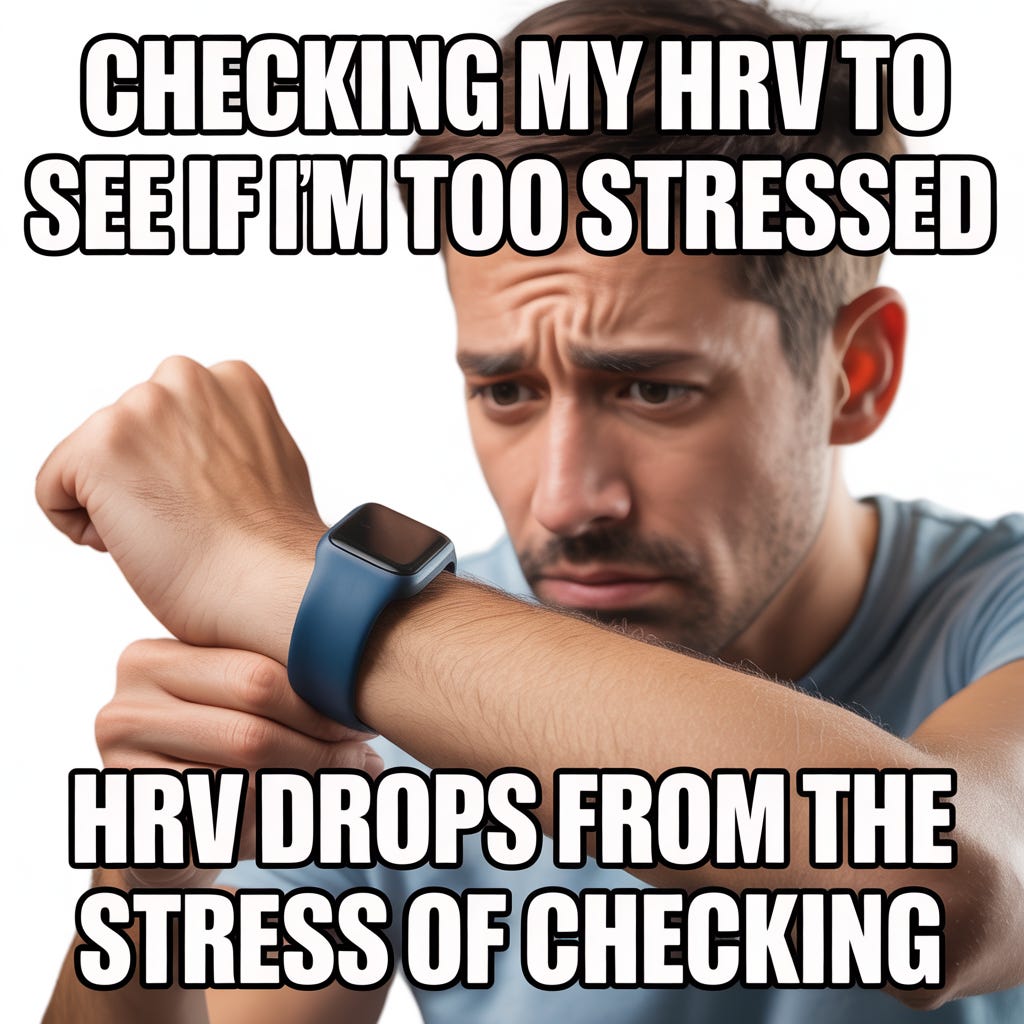
(And yes: if your HRV drops every time your wearable dies mid-run, you’re not alone. The quantified self is nothing if not self-fulfilling.)
A Bit More Of The ‘Science’
Greater heart rate variability (HRV) is widely perceived as a marker of better health because it reflects the dynamic flexibility and adaptability of the autonomic nervous system—specifically, the balance between the parasympathetic (vagal) and sympathetic arms. Here’s why this is regarded as beneficial:
When HRV is higher, it suggests a strong influence from the vagus nerve (the main parasympathetic highway), meaning the body can downregulate stress responses efficiently and engage in restorative processes. Physiologically, this translates to a heart and nervous system capable of rapidly adjusting to changing demands—responding quickly to threats, but also relaxing promptly afterward. (1) (2) (3)
This adaptability is critical because day-to-day life is full of stressors and recovery phases. A system that is too rigid (low HRV) has trouble switching gears and is more likely to be stuck in prolonged fight-or-flight mode, which is linked to higher inflammation and cardiovascular risk. Conversely, good cardiac autonomic modulation (which yields higher HRV) supports not just physical but also psychological resilience—meaning people are better equipped to adapt to stress, recover from illness, and maintain overall health. (4) (5)
Specifically, patterns like respiratory sinus arrhythmia—where heart rate accelerates subtly with inspiration and slows with exhalation—are manifestations of this “vagal brake.” The more pronounced this rhythmic modulation, the more effectively the body can maintain homeostasis and manage environmental and internal demands. (6)
In short: higher HRV is prized because it is a window into robust parasympathetic control and nervous system adaptability. This capacity underlies a host of positive health outcomes, from cardiovascular and metabolic health to psychological wellbeing. It’s not about “more is always better,” but rather, a higher HRV (within normal, healthy ranges) consistently signals that a person’s physiological systems are responsive, balanced, and resilient. But…
There are several important limitations to the idea that “the more variable, the better” when it comes to HRV—along with some real-world concerns around its measurement and interpretation.
1. Individual Variation & Baseline Differences:
Not everyone’s “healthy” HRV looks the same. There are wide normal ranges between individuals, and baseline HRV is heavily influenced by genetics, age, sex, and long-standing lifestyle factors. Some athletes, paradoxically, can show naturally lower HRV that aligns with their physiological adaptation, rather than reflecting poor health. (7) (8)
2. Context: Acute vs. Chronic Changes
Low HRV may signal acute stress, illness, or overtraining, but in some high-performance or very fit individuals, temporary dips could reflect beneficial adaptation or “supercompensation” phases. Conversely, high HRV isn’t always good—certain arrhythmias or neurological issues can elevate variability in ways that do not reflect resilience.
3. Wearables Are Imperfect
Consumer trackers’ HRV algorithms have varying reliability, particularly outside of deep sleep or rest. Noise from movement, poor sensor contact, or device differences can significantly skew readings, leading to misinterpretation. (9) (10)
4. Lack of Outcome Evidence for the Average User
While HRV is a useful research variable and a signal of ANS (autonomic nervous system) health, there is little evidence that tracking HRV improves long-term outcomes for most healthy individuals. Interventions or lifestyle changes based solely on HRV readings (rather than symptoms or broader context) haven’t been shown to provide measurable health advantages on their own. (11) (12)
5. Psychological Pitfalls: Data Anxiety and Hypervigilance
HRV-tracking can drive health anxiety, hyperfocus on “scores,” and increased stress—ironically lowering HRV further. For some, constant monitoring becomes another source of worry. (13)
6. “Healthy User Bias”
HRV’s popularity surges mostly among the already health-conscious, so the positive outcomes seen in groups that monitor HRV may be due to their overall lifestyle, rather than the measurement or its optimization per se. There’s no compelling evidence that the act of tracking HRV itself leads to the beneficial effects seen in these populations.
What About Healthy People Who Never Measured HRV?
Plenty of people have been perfectly healthy, resilient, and long-lived without ever tracking HRV or other wearables. For most of medical history, health was assessed by how you actually felt, performed, adapted to stress, and recovered from illness. Human beings possess a robust capacity for self-regulation and adaptation that manifests through subjective wellbeing, not just numbers. In practice, HRV can offer insight or early warning about overtraining, stress, or burnout, but it should be a tool—not a replacement for listening to your own body.
In summary, HRV is an intriguing piece of the health puzzle, but it’s not a gold standard for everybody, or a replacement for clinical assessment, personal experience, or self-awareness. Used wisely and with humility, it can help recognize trends. Used naively or obsessively, it often causes more confusion than clarity.
References
https://www.sciencedirect.com/science/article/pii/S1568163724003398
https://pmc.ncbi.nlm.nih.gov/articles/PMC6996447/
https://www.mdpi.com/1424-8220/21/12/3998
https://www.nature.com/articles/s41598-025-12430-8
https://www.spandidos-publications.com/10.3892/mi.2025.236
https://pmc.ncbi.nlm.nih.gov/articles/PMC5624990/
https://journals.sagepub.com/doi/full/10.1177/17479541251335613
https://www.researchgate.net/publication/393434965_Associations_between_training_load_heart_rate_variability_perceptual_fatigue_sleep_and_injury_in_endurance_athletes_during_a_12-week_training_mesocycle
https://www.researchgate.net/publication/384391970_The_Validity_of_Apple_Watch_Series_9_and_Ultra_2_for_Serial_Measurements_of_Heart_Rate_Variability_and_Resting_Heart_Rate
https://academic.oup.com/iwc/article/38/1/1/8214201?login=false
https://pmc.ncbi.nlm.nih.gov/articles/PMC11374139/
https://www.health.harvard.edu/blog/heart-rate-variability-new-way-track-well-2017112212789
https://pmc.ncbi.nlm.nih.gov/articles/PMC10742885/
Recent research shows that gut microbiome diversity directly correlates with HRV levels. A healthier, more diverse gut environment enhances vagal tone through the "gut-brain axis," independently of exercise or sleep quality.