

The Cholesterol Con: Why Everything You've Been Told About Heart Disease Might Be Complete Rubbish

A conversation with Dr Malcolm Kendrick that will make your cardiologist’s head explode (metaphorically speaking—we don’t want any actual endothelial damage)
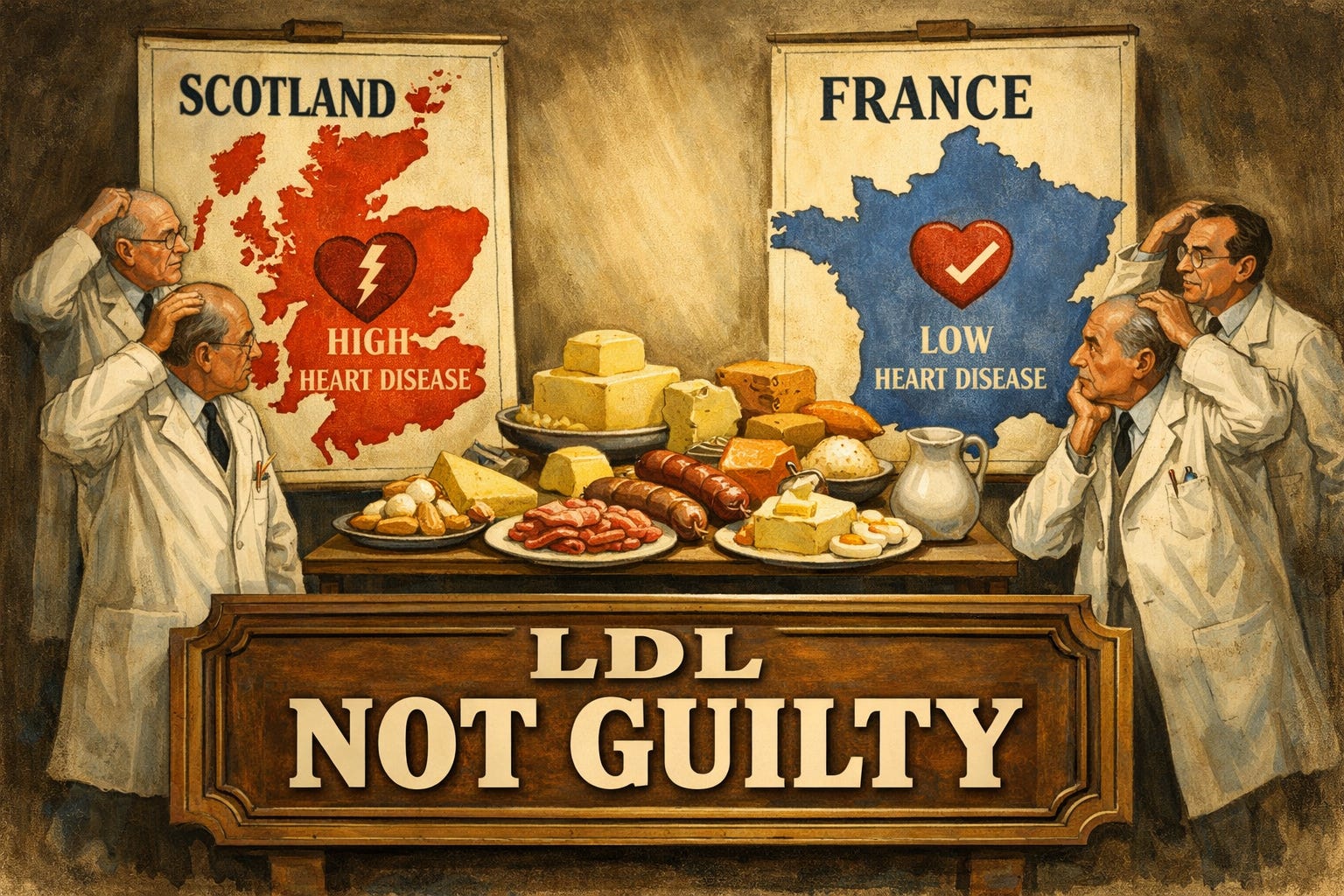
Picture this: Scotland in the 1980s. The rain is relentless, the diet is legendarily terrible, and medical students are being solemnly informed that their compatriots are dropping dead from heart disease because they eat too much saturated fat, which raises their cholesterol, which clogs their arteries. Write it down, pass the exam, and become a doctor. Simple, right?
Except there was one problem. A young medical student named Malcolm Kendrick kept popping over to France to ski. And whilst navigating the Alps, he couldn’t help but notice that the French were absolutely gorging themselves on saturated fat—butter, cream, cheese, the works—yet somehow managed to have the lowest rate of heart disease in Europe, whilst the Scots, supposedly dying from their fatty diet, had the highest.
This cognitive dissonance would set Dr Kendrick on a decades-long journey that would culminate in challenging one of medicine’s most sacred cows: the lipid hypothesis of heart disease.
When Statistics Go to the Dark Side
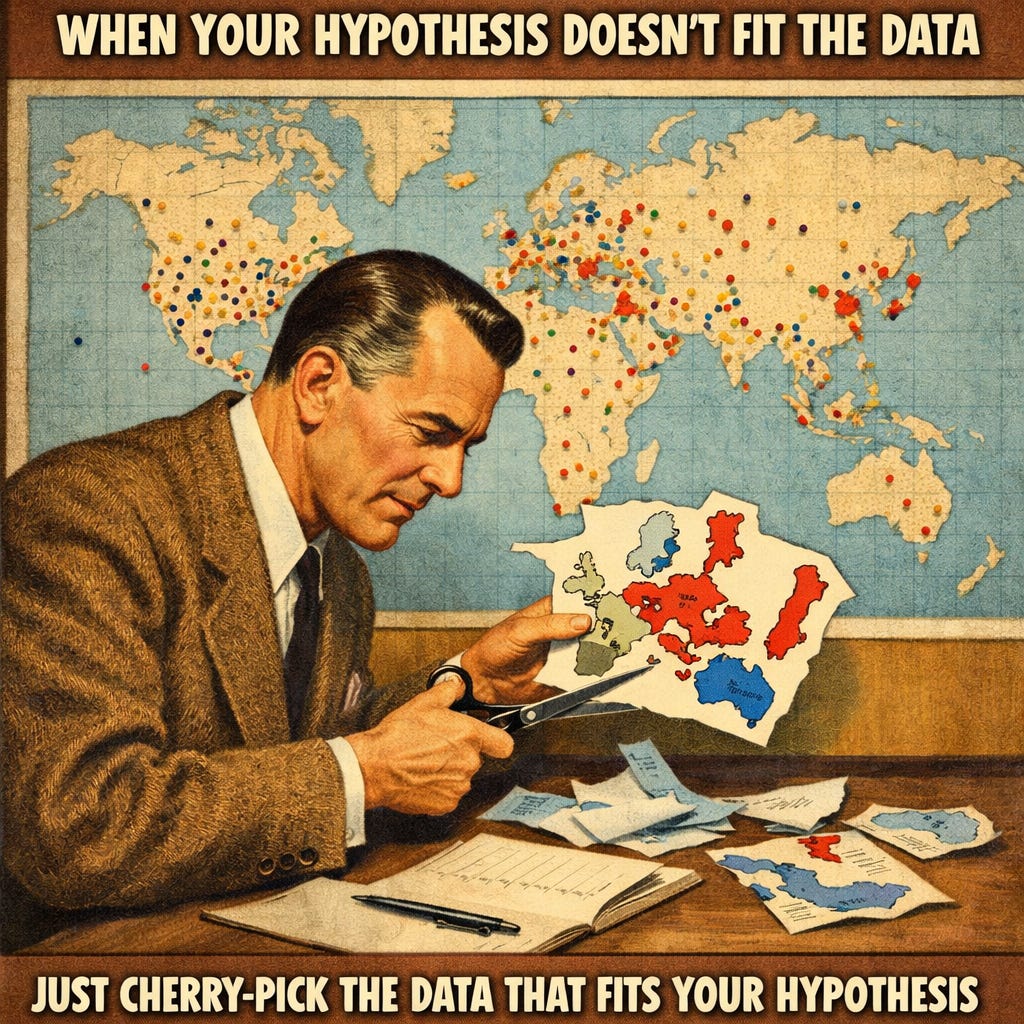
Let’s start with the grandfather of the saturated fat hypothesis: Ancel Keys. In the 1950s, Keys produced his now-infamous graph showing a clear correlation between saturated fat consumption and heart disease. There was just one tiny problem—he cherry-picked his data like a contestant at a fruit-picking championship who only wants to win by cheating.
Did France make it into his graph? No. Switzerland? Nope. Belgium? Absolutely not. Russia, Ukraine, or any other country that completely contradicted his hypothesis? Not a chance. Keys selected countries like Finland, the US, and Britain—ones that conveniently supported his theory—and ignored the rest.
Dr Kendrick decided to do something radical: he looked at all the European data. What he found was extraordinary. The five countries with the highest saturated fat consumption had the lowest rates of heart disease. The five countries with the lowest saturated fat consumption (Ukraine, Georgia, Russia) had heart disease rates six times higher.
It was, in Kendrick’s words, “like the Daleks when they exterminate someone—black is white and white is black.”
The Great Cholesterol Shell Game
Here’s where things get properly ridiculous. Try to pin down exactly what “cholesterol causes heart disease” actually means, and you’ll find yourself in a maddening game of medical whack-a-mole.
Is it total cholesterol? No, wait, we’re talking about LDL cholesterol—the “bad” one. Actually, hang on, we mean the ratio between HDL and LDL. No, sorry, we’re referring to oxidised LDL. Or perhaps it’s light, fluffy LDL particles versus small, dense ones?
The absurdity reaches its peak when you discover that Q-risk 3—the UK’s official cardiovascular risk calculator with 20 different risk factors—doesn’t even include LDL as a measurement. Read that again. The substance supposedly causing heart disease isn’t deemed important enough to measure when calculating your risk of getting it.
As Kendrick puts it, attacking the cholesterol hypothesis is like attacking a jet fighter that releases chaff: your missile has no idea what to target anymore.
The Black Swan That No One Wants to Talk About
Remember Karl Popper’s black swan argument? Finding a thousand white swans doesn’t prove all swans are white, but finding one black swan proves they’re not.
Enter the torcetrapib drugs—a family of medications tested about 20 years ago. These pharmaceutical marvels lowered LDL more than statins and raised HDL by a whopping 150%. According to the cholesterol hypothesis, they should have been wonder drugs.
Instead, trials involving thousands upon thousands of patients showed... nothing. No cardiovascular benefit whatsoever. In fact, some studies showed an increase in cardiovascular events.
What happened? The drugs weren’t launched, and somehow, most doctors—even cardiologists—have never heard of them. It’s almost as if finding a black swan that completely disproves your hypothesis is deeply inconvenient when you’ve built an entire medical industry around said hypothesis.
When confronted with this evidence, the response from defenders of the cholesterol hypothesis is essentially: “Well, these drugs must have done something else that increased heart disease risk.” This is the medical equivalent of the dead man saying, “Well, I guess dead people do bleed.”
What Actually Causes Heart Disease? Enter the Blood Clot
So if it’s not cholesterol, what’s really going on? Kendrick’s alternative theory—actually first proposed by Rokitansky in 1852 and later championed by Dr. Elizabeth Smith at Aberdeen University—is beautifully simple: heart disease is fundamentally about blood clotting and endothelial damage.
Here’s how it works:
Your arteries are lined with a single layer of endothelial cells, protected by a gel-like coating called the glycocalyx (basically an unkempt lawn made of glucose-protein strands). When this protective layer gets damaged—through smoking, diabetes, high blood pressure, air pollution, cocaine, gum infections, or countless other factors—the endothelial cells underneath get stripped away.
When endothelial cells are damaged, your body does what it’s designed to do: it forms a blood clot to patch the damage. This clot contains platelets, red blood cells, white blood cells, clotting factors, fibrin, and yes, LDL, because LDL is part of the clotting mechanism.
Here’s the clever bit: your body can’t just let that clot sit there and then break off later (you’d have a stroke or heart attack every time you got a paper cut). Instead, endothelial progenitor cells—made in your bone marrow—migrate to the site, stick to the clot, and grow a new layer of endothelium over the top of it.
The blood clot is now incorporated into your artery wall. That’s what a plaque is—the remnant of a blood clot in various stages of repair.
The Cholesterol Crystal Conundrum
“But wait!” cry the cholesterol defenders. “We find cholesterol crystals in plaques! That proves cholesterol causes heart disease!”
Not quite. Here’s a biochemistry lesson that apparently everyone forgot:
LDL carries cholesterol around as cholesterol esters—one cholesterol molecule attached to a fatty acid. You cannot make cholesterol crystals from cholesterol esters. It’s chemically impossible.
You can make cholesterol crystals from pure cholesterol. And there are only two places in the body with high concentrations of pure cholesterol: neurons in your brain and the membranes of red blood cells.
When you find cholesterol crystals in plaques, you’re looking at the remnants of red blood cells that were incorporated into a blood clot. It’s evidence for the clotting theory, not the lipid hypothesis.
The Risk Factors That Actually Make Sense
Once you understand the blood clotting mechanism, suddenly all the risk factors for heart disease make perfect sense:
Smoking: Strips away the glycocalyx and kills endothelial cells. One cigarette causes measurable endothelial damage.
Diabetes: Chronically elevated blood sugar strips away the glycocalyx like acid rain on limestone.
Cocaine: Literally strips endothelial cells off your blood vessel walls. The number one risk factor for heart attacks in young British men? Taking cocaine increases your risk 30-fold within an hour.
Gum disease (periodontitis): Increases heart disease risk by 300%. The bacteria release toxins that damage the endothelium.
Sickle cell anaemia: Sharp, pointy red blood cells hammer through your blood vessels like microscopic knives. Result? A jaw-dropping 50,000% increase in cardiovascular risk.
Systemic lupus erythematosus (SLE): An autoimmune disease where the body attacks phospholipids—the main component of cell membranes. Young women with SLE have a 5,000% increased risk of cardiovascular death because their immune systems are literally attacking their endothelial cells.
COVID-19: The virus enters cells via ACE2 receptors, which are prominently found on endothelial cells. The immune system attacks infected cells, causing widespread endothelial damage and the blood clotting complications we saw during the pandemic—the infamous “cytokine storm.”
None of these risk factors primarily affects LDL levels. But they all damage the endothelium and glycocalyx.
The Nitric Oxide Revelation
Here’s where statins get interesting—but not for the reason you think.
Nitric oxide wasn’t even discovered in the human body until the mid-1990s. It’s the most potent natural anticoagulant and crucial for cardiovascular health. It keeps blood vessels open, supports endothelial cell production, and prevents clotting.
You know what increases nitric oxide synthesis? Statins. Dramatically.
You know what else increases nitric oxide? Viagra. That’s literally how Viagra works—by helping the body synthesise nitric oxide, which opens up blood vessels (everywhere, not just where you’re thinking).
Type “statins nitric oxide synthesis” into Google and you’ll find 10,000 papers. Statins have 36 recognised effects on the body. The idea that their cardiovascular benefit comes solely from lowering LDL—rather than from increasing nitric oxide—is a marketing hypothesis, not a scientific one.
The Statin Scandal: When Research Becomes Propaganda
Now we arrive at the really juicy bit: the recent Lancet paper claiming statin side effects are all in your head—the dreaded “nocebo effect.”
This paper came from the Cholesterol Treatment Trialists’ Collaboration (CTT) at Oxford, led by Rory Collins, Colin Baigent, and Jane Armitage. These are the same people who have spent 30 years insisting statins have no adverse effects and attacking anyone who dares suggest otherwise.
In 2019, Dr Kendrick and colleagues were actually sued by the Mail on Sunday for supposedly “killing thousands” by suggesting statins had adverse effects. Behind the scenes, the CTT group was advising the journalist on how to attack them. Kendrick has the emails to prove it.
The CTT group holds all the raw data from pharmaceutical company statin trials in its vault. They won’t let anyone else see it. Ever. You either trust them implicitly or you don’t.
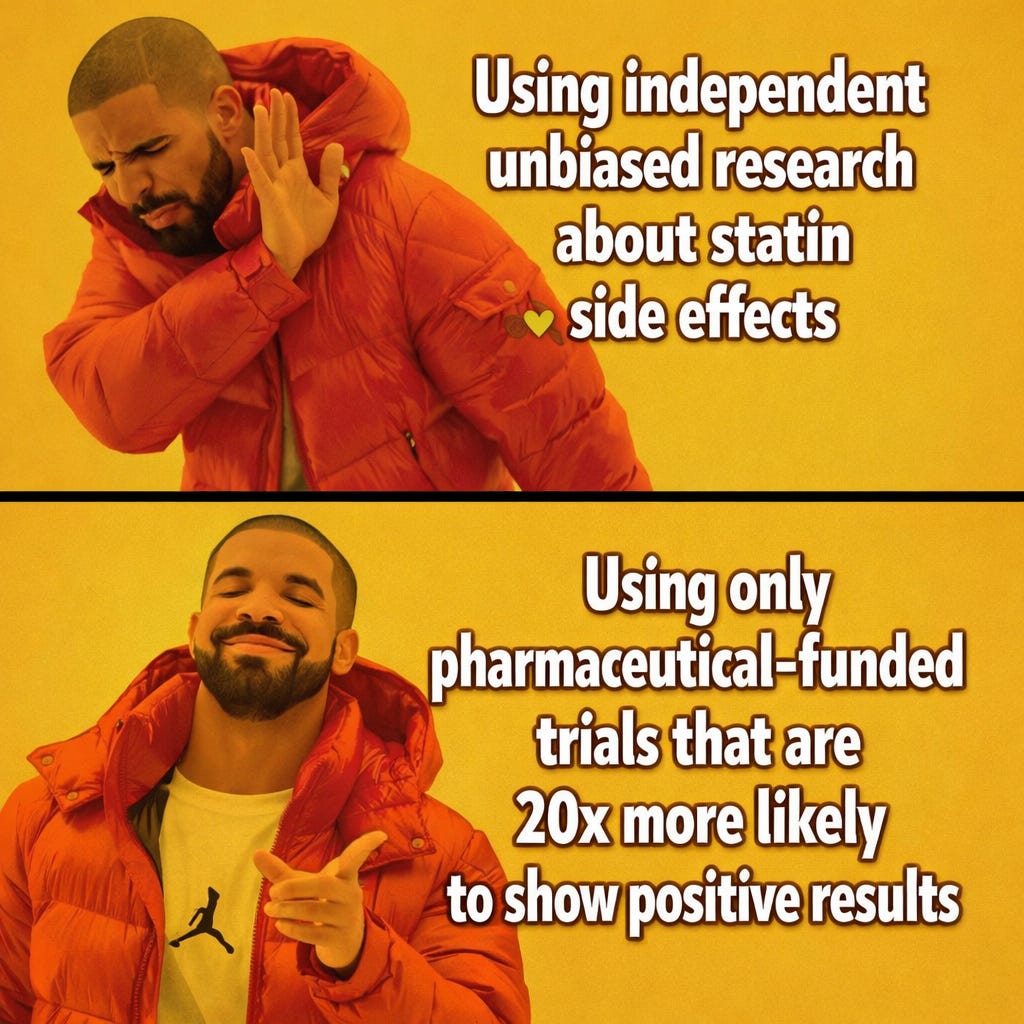
Their Lancet paper claimed to use only “unbiased” data—namely, pharmaceutical-industry-funded randomised controlled trials. They rejected all other research as potentially biased.
There’s just one problem: research into bias in statin studies, conducted by Ben Goldacre (no friend of Kendrick’s), found that pharmaceutical-funded trials are 20 times more likely to produce positive results for statins than independent trials.
So they rejected “possibly biased” independent research and used only the most biased research available. Brilliant.
The Statistical Shenanigans
The problems get worse:
They set a 5% threshold, claiming any adverse effect affecting fewer than 5% of people could be ignored as “false positives”—essentially made up by patients.
They said you couldn’t compare adverse effects between different trials because the populations were too different, yet simultaneously used those same trials to do meta-analyses proving statins’ benefits.
They found wildly inconsistent adverse-effect rates across studies: 3% in one (for both statin and placebo), 83% in another (again, for both statin and placebo). How can placebo adverse effects vary from 3% to 83%? They can’t explain it.
The IDEAL study used the same drug (simvastatin) at the same dose as the 4S study, in a virtually identical population. Adverse effects in 4S? 6%. Adverse effects in IDEAL? 94.4%.
Not side effects like “a bit of a headache”—we’re talking serious adverse events: death, hospitalisation, permanent disability. In IDEAL, the serious adverse event rate was 47%.
Their explanation? “We’re looking at different populations.” The populations differed by an average of three years in age.
The Grand Conspiracy Theory (That Might Not Be a Theory)
The CTT paper’s ultimate aim? To remove adverse effect information from patient leaflets because, supposedly, people read them and imagine they’re having side effects.
There’s no evidence that anyone even reads these leaflets, let alone that reading them causes nocebo effects. But that doesn’t matter. What matters is that these leaflets are legal documents. Pharmaceutical companies are legally required to list adverse effects found in clinical trials.
Removing the leaflets removes one of the few remaining sources of objective information about statin side effects.
The Familial Hypercholesterolaemia Red Herring
“But what about familial hypercholesterolaemia (FH)?” cry the defenders. “People with very high LDL levels get heart disease young! Explain that!”
Kendrick does brilliantly:
First, the absolute numbers are tiny—perhaps four people annually in the entire UK under 40 die from cardiovascular disease with FH.
Second, FH involves genetic variants affecting LDL receptors. But here’s what they don’t tell you: the same genes that create LDL receptors also affect clotting factors. And LDL receptors don’t just remove LDL from the bloodstream—they also remove clotting factors.
Twin studies show that when one twin has the clotting factor gene variants and the other doesn’t, the one with clotting abnormalities dies young whilst the other lives a long, healthy life—despite both having sky-high LDL.
Oh, and people with FH? On average, they live longer than the general population.
Not a single randomised controlled trial has ever been done showing that lowering LDL in FH patients improves outcomes. Not one.
The Elderly Paradox
Here’s my favourite bit of evidence: Kendrick co-authored a paper looking at LDL levels in elderly people (over 60). They reviewed 19 studies.
The finding? The higher your LDL level, the longer you live.
This was consistent across all studies.
Imagine if smoking caused lung cancer in young people but prevented it in older people. That would sound utterly ridiculous, wouldn’t it? Yet that’s essentially what the cholesterol hypothesis is asking us to believe.
What This All Means
We’ve spent 70 years and hundreds of billions of pounds/dollars pursuing a hypothesis that was based on cherry-picked data, has been repeatedly contradicted by subsequent research, and requires increasingly tortuous logic to maintain.
Meanwhile, the actual mechanism—endothelial damage, blood clotting, and repair—has been sitting there in plain sight since Rokitansky identified it in 1852.
Does this mean throw away your statins? Not necessarily—they do seem to have a modest benefit, likely through increasing nitric oxide rather than lowering LDL. But it does mean we should:
Stop demonising saturated fat and dietary cholesterol
Focus on factors that genuinely damage the endothelium (smoking, chronic hyperglycaemia, air pollution, chronic infections)
Investigate treatments that support endothelial health and nitric oxide production
Demand transparency in pharmaceutical research
Stop pretending that an entire class of drugs has no significant adverse effects when patient experience clearly demonstrates otherwise
The Final Word
Dr. Kendrick isn’t claiming to have all the answers. But he’s asking the questions that desperately need asking—and following the evidence wherever it leads, even when it contradicts 70 years of medical dogma.
In his own words: “The only change will not come from within the medical research world. They don’t care. It will only come when the public get upset enough and think this is ridiculous.”
So, are you upset yet?
Ready to dive deeper into the real science of metabolic health? Join the Common Sense Carnivore community where we cut through the nutritional nonsense and focus on what actually works: https://www.skool.com/common-sense-carnivore/plans
Premium members receive:
The comprehensive “Guide to Blood Tests in the Context of Low-Carb, Keto, and Carnivore”
“How To Be Carnivore” eBook
Access to our like-minded, common-sense community
Because sometimes, the truth about health isn’t in the textbooks—it’s in the data they didn’t want you to see.
Disclaimer: This article is for educational and entertainment purposes only and is not medical advice. If you’re considering any changes to your medication or health regimen, consult with a qualified healthcare practitioner who actually reads beyond pharmaceutical company press releases.
Watch the video here
There are trillions of dollars and pounds being made pushing the whole cholesterol thing and it’s all based upon a fraudulent premise. Keys actually proved his own theory wrong he did a RCT on patients in Minnesota mental institutions where he had complete control of their diets. Replaced the saturated fats with corn oil. Lowered their cholesterol and increased the number who died of cardiovascular events. So what did the good scientists do? Yep he hide the data. After he died the raw data was found and analyzed and published but by then it was too late the lie has too much money behind it now.
I'm dealing with this now. Non-diabetic, non-smoker, female, 62.
Once I convinced my new hcp that I wasn't on the verge of a thyroid storm (not a lot had changed in 10 years, and nothing about me presents as hyperthyroid), she pounced on my cholesterol. I nipped the statin convo in the bud, and left with a sheaf of dietary recommendations that looked dreary.
And all this because I wanted to discuss hrt