

Your Triglyceride Test Isn't Testing Triglycerides
The biochemical plot twist nobody told you about — and why it matters more than you think

A huge nod of appreciation to Eddie Goeke, one of the genuinely knowledgeable voices in the carnivore and metabolic health space. Eddie contributes content to the Carnivore Certification Programme — a proper, internationally accredited qualification for those who want to coach with real credentials rather than just a ring light and strong opinions. He recently did a deep dive into something I flagged for him, complete with a citation to back it up, and I thought it deserved a proper article treatment. So here we are.
Right. Let’s talk about triglycerides — or more specifically, let’s talk about the fact that your triglyceride test isn’t actually measuring triglycerides.
Go on, read that again. I’ll wait.

What even is a triglyceride?
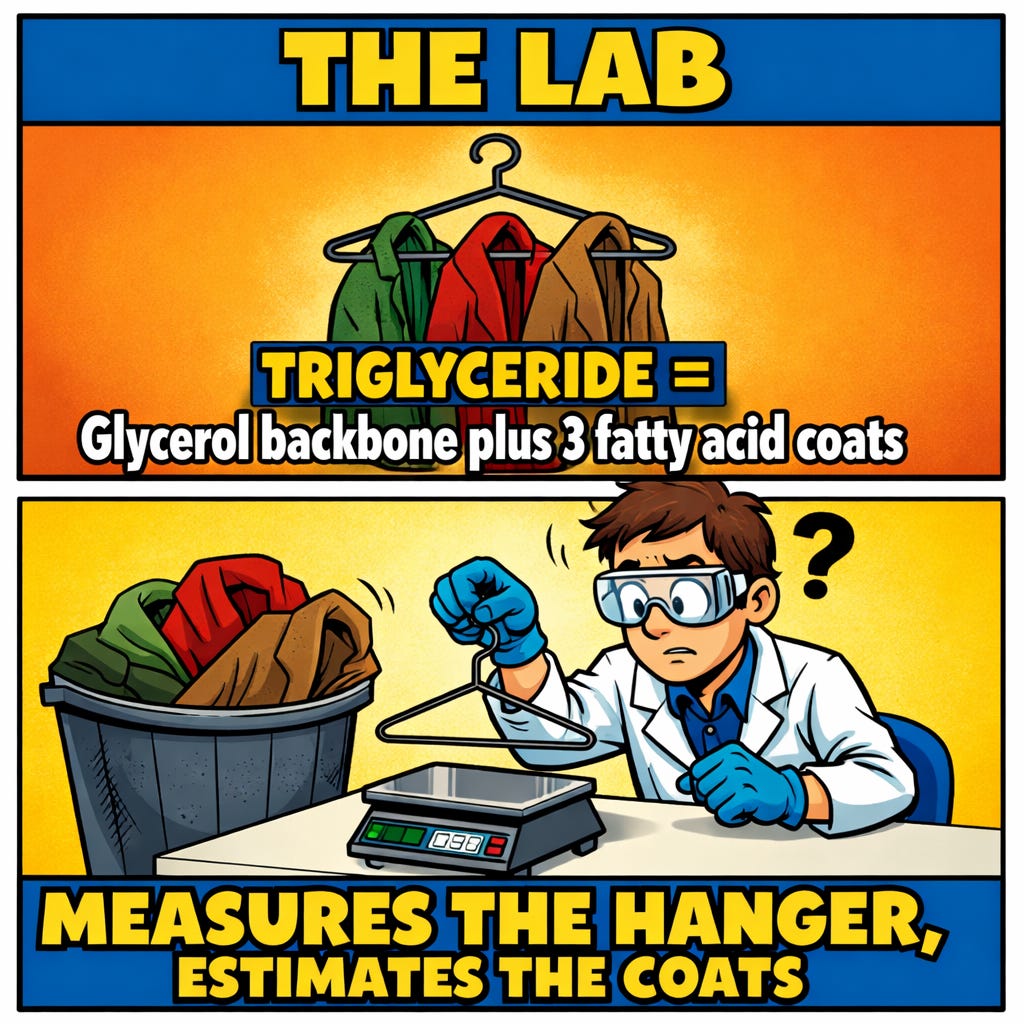
A triglyceride is, at its most basic level, a glycerol molecule with three fatty acids attached to it. Think of glycerol as a little coat hanger, and the three fatty acids are the coats hanging off it. Together, they make a neat little storage package – fat, essentially, in its transport and storage form. When your body decides it wants to store energy, it packs it up as triglycerides and ships them off to adipose tissue (fat cells) and muscle cells and, in less desirable circumstances, the liver and organs — hello, visceral fat.
So when your doctor orders a triglyceride test, you’d be forgiven for assuming that what comes back is a direct measurement of those little coat-hanger molecules floating around in your blood. You’d also be wrong.
The glycerol problem
Here’s where it gets interesting — or infuriating, depending on your mood.
Standard laboratory triglyceride assays don’t measure intact triglyceride molecules at all. Instead, they enzymatically break the triglyceride apart – hydrolyse it – releasing the fatty acids from the glycerol. They then measure the glycerol using a series of enzymatic steps (the GPO-PAP method, if you want the technical name to drop at dinner parties). The triglyceride concentration is then calculated from that glycerol signal.
So the test measures glycerol and then works backwards to estimate triglycerides. Not exactly a direct readout, is it?
Now here’s why that’s a problem, and it comes straight back to basic biochemistry. When your body is burning stored fat – lipolysis, the breakdown of triglycerides – what does it release? Free fatty acids, yes, which are carried through the blood by albumin. But it also releases glycerol. Free glycerol. Which, being water-soluble, flows freely through the bloodstream.
So if you’re someone who’s actively burning (oxidising) fat — you know, someone eating carnivore or keto, someone in a nutrient deficit, someone doing fasted exercise — you already have elevated free glycerol circulating in your blood before anyone sticks a needle in your arm. That free glycerol is metabolically legitimate. It’s the byproduct of your body doing exactly what you want it to do.
The problem? The lab can’t tell the difference.
When the assay breaks your triglycerides apart to measure glycerol, it’s also picking up all that pre-existing free glycerol from lipolysis. And since the test assumes all glycerol came from triglycerides, it inflates the reading. Your result comes back higher than your actual triglyceride level. You look at the number and panic. Your doctor looks at the number and reaches for a prescription pad.
This isn’t a conspiracy theory. The research states it plainly — “pre-existing free glycerol in the sample from metabolism, sample handling, or exogenous sources can falsely raise the apparent triglyceride value.” In other words, the labs know about it.

Some labs correct for this. Some don’t.
A free glycerol blanking step exists — a separate measurement of free glycerol that gets subtracted from the final figure to avoid this positive bias. Some labs use it. Some don’t. Which means that depending on where your blood was processed, your triglyceride result may or may not reflect reality. Two people with identical metabolic health could get meaningfully different numbers purely because of which reagent kit the lab happened to be using that week.
To use an analogy: it’s a bit like trying to weigh your luggage at the airport while your toddler is sitting on the scales and you’re not entirely sure whether the person behind the desk has accounted for the toddler or not. The number you see may or may not reflect the thing you’re actually trying to measure.

And this isn’t even the only blood test doing this
We already know that LDL isn’t directly measured in most standard lipid panels — it’s estimated using a regression equation (the Friedewald formula, or its various updated versions), which introduces its own layer of imprecision, particularly at lower triglyceride levels or in very low-carb dieters. Now we can add triglycerides to the list of values that aren’t quite what they appear to be.
Remember, interpreting blood results in the context of a carnivore or ketogenic way of eating is absolutely crucial. The standard reference ranges were derived from population data, and that population largely consists of people attending doctors’ offices, people who are metabolically unwell, and people who eat the standard Western diet. You are not that population. Applying those ranges uncritically to someone who is actively mobilising fat, running on ketones, and eating nose-to-tail is a category error.
What should you actually be looking at?
If you’re genuinely trying to gain meaningful insight into your metabolic health, Eddie makes a strong case — and I agree — for prioritising fasting insulin and fructosamine. Fasting insulin tells you how hard your pancreas is working to manage your blood glucose and gives you a real sense of insulin sensitivity. Fructosamine gives you a shorter-term picture of glycation than HbA1c, which is useful for tracking trends. And yes, a solid inflammation panel — hs-CRP as a minimum — is worth having in the mix.
These are markers that tell you something functional about what’s happening in your body. Not a surrogate estimate of a molecule that was never directly measured in the first place.
The bigger picture
None of this means blood testing is useless. It absolutely isn’t — I’ve built much of my work on helping people understand and contextualise their results rather than fear them. But blood testing is a tool, not a verdict. And like any tool, its usefulness depends entirely on understanding what it actually measures, how it measures it, and what the result means in the context of your diet, your physiology, and your overall clinical picture.
A high triglyceride result in someone on a high-carb diet is telling one story. A borderline elevated result in someone who fasted overnight, trained in the morning, and is actively in lipolysis might be telling quite a different story. The number is the same. The meaning is not.
The fact that Eddie is weaving this level of biochemical nuance into a proper accredited certification programme — one that gives coaches real credentials, real accountability, and the ability to communicate credibly with medical professionals — is genuinely important. The carnivore and keto space has too many people confidently dispensing advice from a position of half-understood YouTube content. That’s not a dig; it’s just reality. This programme is part of the solution.
If you’re thinking about stepping into coaching, or if you want to deepen your own understanding rather than just your Instagram presence, it’s worth looking at seriously. You can find out more and schedule a free call with Carnivore Coach Peter, who leads the programme, to see if it’s the right fit.
And while we're on the subject of blood tests not telling the whole story, here's another one to chew on. Your fasting glucose reading — that reassuringly normal number your doctor circles with a satisfied nod — tells you absolutely nothing about how much insulin your body had to produce to achieve it. A glucose level of 5.0 mmol/L in one person might have required barely a whisper of insulin. In another, it may have taken a heroic hormonal effort that's been quietly running in the background for years. The number looks identical. The metabolic reality underneath it could not be more different. It's a bit like two people both arriving at work on time – one walked round the corner; the other sprinted three miles in the rain. Same outcome, wildly different cost. This is such a fundamentally important concept that it deserves far more than a paragraph—so I'm dedicating a full Substack article to it at a later date. So watch this space, because once you understand it, you'll never look at a glucose result the same way again.
As always, if you want to understand your blood results in the context of a low-carb, keto or carnivore way of eating, my Guide to Blood Tests is available to premium members of the Common Sense Carnivore community. Thousands of people have already found it genuinely useful — not because it tells them what they want to hear, but because it tells them what the numbers actually mean.
Come and join us over at the community – link below. And remember: your triglyceride test might not be measuring triglycerides, but at least your steak is still definitely a steak. Some things remain reassuringly straightforward.
Want to join a like-minded community of people approaching health with common sense? Come and find us at https://www.skool.com/common-sense-carnivore/plans
Ready to take your understanding further with a consultation? Book at
http://ukcarnivorecoach.com/
Coaching Program Website: https://www.carnivorecoachinternational.com/courses/carnivore-coach-certification
Coach Peter’s email: petescarnivorecoaching@gmail.com
Becoming as informed as possible with the actual facts is essential. When you know better you do better.
So if LDL is caclulated and not measured, and triglycerides are not measured directly - what is being measured on a basic lipid panel?